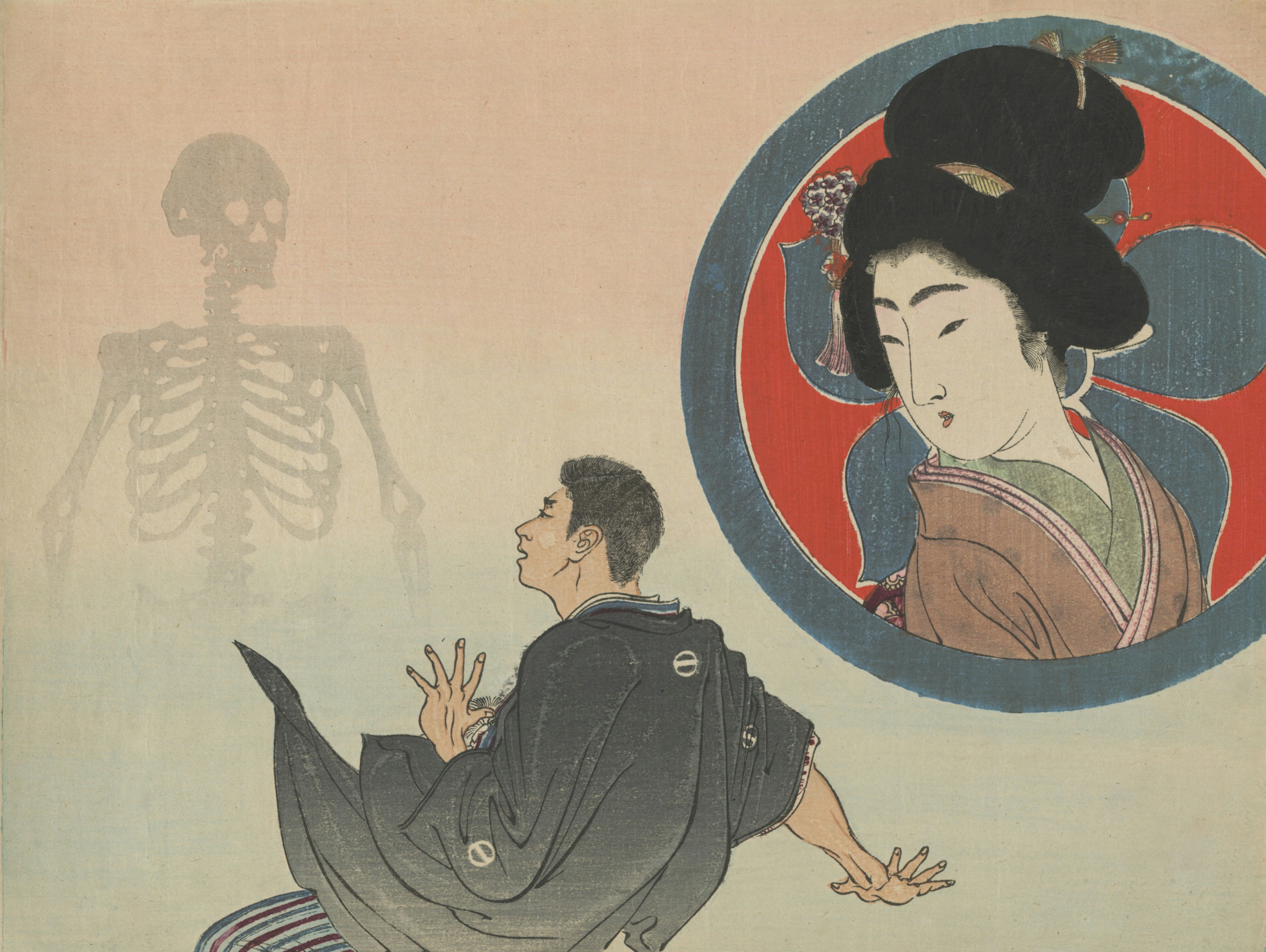
They are quite easily overlooked, aren’t they? Japanese woodblock prints I mean. They are not particularly big, they are not particularly bright and colourful – at least in their given state – and they don’t look particularly precious at first sight. In fact, if you just walk past them in a museum because you came to see something entirely different and are way more interested in getting to what you actually came for, they might have the appeal of old newspapers. They are not something that makes you stop and take a closer look in a situation like that – even though you most certainly should.
Because that’s the thing with this kind of art – like with so many other things in life. These prints are precious, not because they are very impressive at first sight, but because they develop a very strong appeal from the moment that you start to really engage with them. They become intensely fascinating not by glancing at them, but by studying them. Once you do that, you actually do take a pause in front of one of these pictures during your long tour through the way too busy museum and really invest in the moment, you will see why they are called Ukiyo-e, the Japanese term for Pictures of the Floating World. For it is this floating world you will be drawn into.
Originally, Ukiyo-e prints had their heyday in the 18th and 19th centuries. In Japan this was a time marked by lasting structural changes. The city of Edo – modern-day Tokyo – became the seat of the ruling shogunate and in turn grew rapidly, not only in size but also economically. In short, it was one of those few but glorious periods in human history when the differences within society did not widen, but actually grew smaller.
The social class that was traditionally positioned at the lower end of the spectrum, the chonin, profited the most and became increasingly wealthy. With this, these merchants, craftsmen and ordinary workers started to indulge in all kinds of activities that had formerly been a luxury. They attended the city’s theatres, they watched their famous sumo wrestlers compete, and of course they flooded the frivolous pleasure districts. But they also began to do another thing that, back then as today, is first and foremost seen as an activity of the upper classes: They became art collectors.
For me, it is here where it starts to get fascinating. Because art, of course, can never be something that stands entirely outside of the society that produces and collects it. Even the most avant-garde art lives from the associations people read into it and the place the artists and their work hold in any given society. This is true for a modern abstract painting like those by Mark Rothko, Jackson Pollock or even Cy Twombly, as much as for the whole genre of Ukiyo-e.
But the taste of the people for whom the art of Ukiyo-e was made was certainly not all too aloof and abstract. No, their main interest was to bring visual representations of their everyday pleasures and experiences into their homes and in this way prolong them into a cold winter evening or a rainy Sunday afternoon. Ukiyo-e prints were first and foremost made to decorate the homes of the chonin class, and through this they not only depicted the world of these people, but in a way were themselves a part of it. It is this deep connection with this fleeting world long gone that makes them so utterly fascinating.
Originally, Ukiyo-e prints were mostly produced in large numbers from a single woodblock, which made them very affordable for their main customers. They depict sumo wrestlers and courtesans, actors and craftsmen, as well as so many other large and small details of contemporary Japan in and around Edo. But that’s by far not all. They also depict fantastic scenes that featured in the tales people told each other and the theatre plays that brought them to life. They show dragons, ghosts and monsters. You can see fighting samurai, naked beauties in love, and frightened fishermen battling the elements. In fact, it is this very last subject that – sounding so utterly humble at first – turned into the most widely recognised artwork of the whole century-spanning genre of Ukiyo-e: The Great Wave off Kanagawa by Hokusai.

The Great Wave, as it is mostly called, was produced in 1831, when Hokusai was already over 70 years old. Originally the print formed part of the series Thirty-six Views of Mount Fuji. But, to be honest, when I saw it for the first time I almost had to search for Mount Fuji – the highest mountain in Japan, measuring more than 3,700 metres above sea level. I had to search for it because its typical snow-covered peak almost disappears between the white foam of the waves, one of which outsizes the mountain at least five times. This is the great wave that gave the print its name, and it is depicted at the very moment when it is about to crash down on several frightened fishermen who cling to three long boats, entirely at the mercy of the elements.
The primordial forces at play here are most directly represented by the swirling crest of the wave, which is not only the highest-reaching element in the print but alone covers almost half of it. But as fascinating as this view is, and as much as it might frighten you – even standing in a very dry and very safe museum – when you put yourself in the position of the pitiable fishermen fighting for their lives, there is something else about this picture that might strike you as uncanny. You might feel as though it reminds you of something you are very familiar with because you have seen it so often before, but you still cannot quite pinpoint what it is you are thinking about.
But then, at some point, the idea might rush through your mind – or it might not, and you might, like I did, require some reading before the realisation comes to you.1 In any case, you will realise that this characteristic swirl of the wave bears a certain resemblance to the most famous painting by Vincent van Gogh, The Starry Night, now in the collection of the Museum of Modern Art in New York.

These similarities are certainly no coincidence – even though, in the absence of an explicit confirmation by the artist, the direct inspiration of one work by the other ultimately remains a matter of conjecture. But some things are certain. Van Gogh painted The Starry Night in 1889 while living in a small mental asylum on the outskirts of Saint-Rémy-de-Provence, where he was admitted following the famous episode of cutting off his own ear. And this was a time when Ukiyo-e prints were very popular not only in France but throughout Europe.
Following the forced reopening of foreign trade in 1858, Japanese goods streamed to the West. Not only Van Gogh himself, but many European artists collected Ukiyo-e prints and let themselves be inspired by them. In my opinion, these facts alone make the direct inspiration of The Starry Night by The Great Wave entirely believable – even though it may have been an unconscious one. But if you also consider that we know of conversations Van Gogh had with his brother about this particular print, in which he called it one of his absolute favourites, then, in my opinion, we enter a realm where it becomes harder to disprove this theory than to believe it.
Furthermore, and quite apart from the question of the direct relationship between these two artworks, “The Great Wave” can certainly count as the proverbial tip of the iceberg. It is just the small peak looking out of the deep, dark waters of all the countless other influences Ukiyo-e prints had on so many well-known and lesser-known European artists and their paintings during this period of European art history, especially among the Impressionists. And through this, the floating world of the chonin, these lowest-class people of the Edo period, found its way into European high culture and education. Pictures that were once designed to decorate humble homes now inspired artists whose paintings found their way not only into the world’s greatest museums, but also into the homes of the wealthy elite.
But that’s of course not where the story ends. Because, as I certainly don’t need to tell you, these paintings then in turn were themselves highly influential on many other aspects of the cultural developments of the following decades. Without the Impressionists, for example, the whole history of modern art might have taken a completely different course. These painters of the 19th and early 20th centuries, like Van Gogh – who was one day sitting in his small room in a very pitiable condition, watching the skies – profoundly influenced the visual appearance of the world in which we ourselves are living today. It is through this profound influence that the ghost of Ukiyo-e walks among us and the fleeting world of the chonin still lives on to this day.
The impulse for this essay originated from a visit to the wonderful special exhibition Japan auf Papier in Dresden. Utamaro, Hokusai, Hiroshige und die Grafik der Moderne at the Kupferstich-Kabinett Dresden.
- https://www.theguardian.com/artanddesign/2018/sep/28/vincent-van-gogh-starry-night-hokusai-great-wave ↩︎
Leave a Note