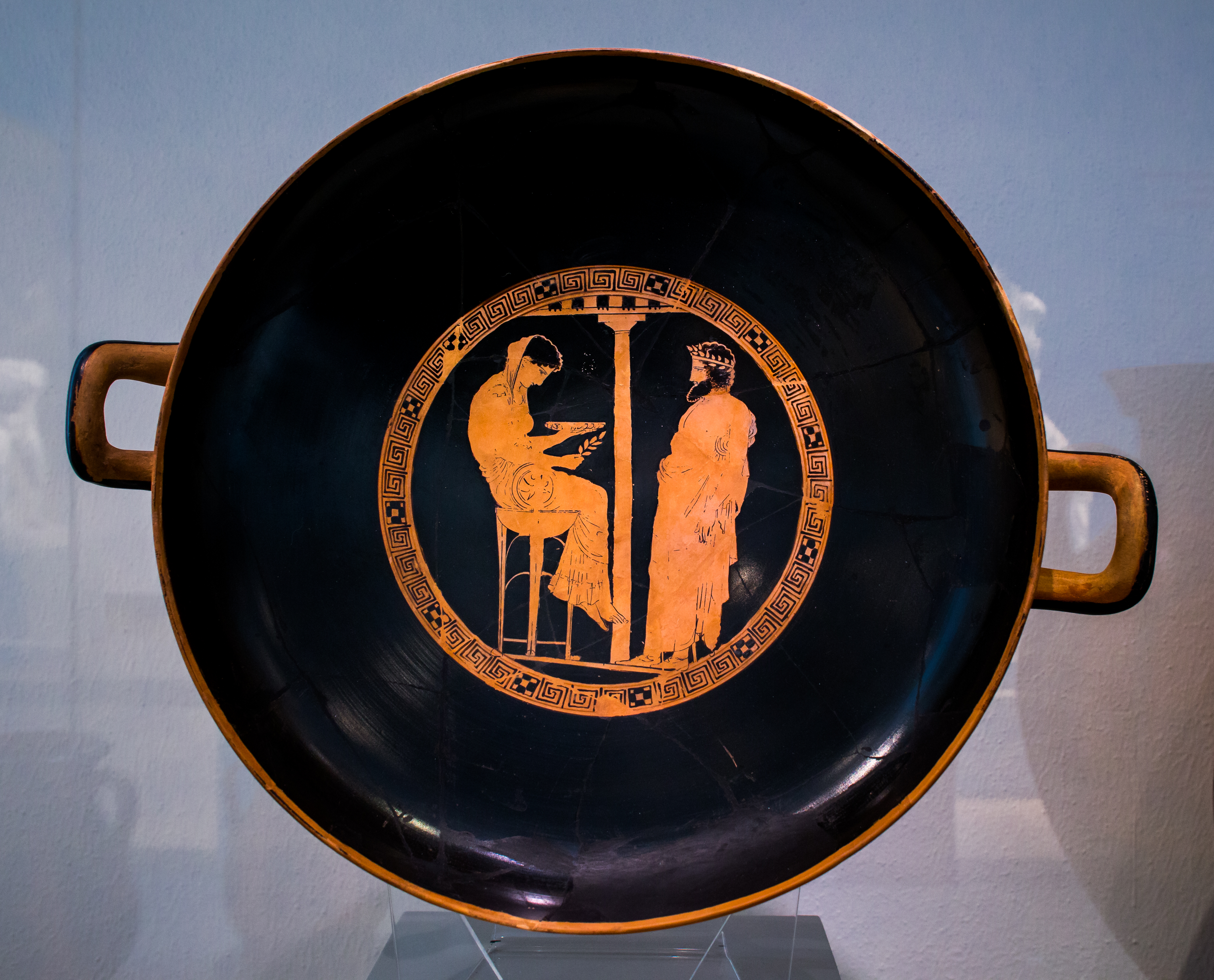
Sometimes in academia you come across phenomena that make you disbelieve your own judgement. This essay is about one of these instances, upon which I stumbled quite a while ago but did not have the time and energy to look into more deeply. But then, when I finally decided to take the matter seriously, I fell into a fascinating rabbit hole at the bottom of which lie, in my personal opinion, not only questions about debatable practices in older as well as more recent scholarship, but also about the nature of academic truth as a whole.
The main protagonist of our drama is an Attic red-figure kylix that can be dated to the fifth century BCE. If you aren’t a Classicist, a kylix is a cup that was used at the symposium, the drinking events of adult males during which not only countless litres of wine were spilled, but just as many stories told and songs sung.
Much of the spilled wine was strong, dark red wine that, with its deep colour, entirely covered the interior of these drinking bowls – which created a nice effect: the large bottom of the bowl was only fully visible after the whole cup had been emptied. And because of this, it was a popular place to show all kinds of pictures that the drinkers could “discover” at some point during the evening. The variety of these pictures is, as one would imagine, huge. They range from pretty harmless depictions of scenes from well-known mythological tales to rather spicy displays of nude hetaerae in the most explicit circumstances.
The cup that is of interest to us today is not of the spicy sort, but it is nevertheless rather well known. The reason for this is quite simple: on its inside, you can see the most famous contemporary depiction of the world-famous oracle of Delphi, or, to be more precise, the priestess called Pythia, who acted as the voice of the god Apollo. But then, is the woman that we see really the Pythia? Because it is here that our trouble begins. Please have a look at our first image:

This picture of the inside of the vase is not a photograph, but a reconstruction drawing. It dates to a period when photography was still in its infancy and very expensive. It was published in 1846 by Eduard Gerhard in a German paper to which we will return later on.1 It is still widely circulated in scholarship today, so I don’t even remember when and where I came across it for the first time.
But to be precise, Gerhard’s paper was not concerned with the vase as such, but with one particular aspect of it. For, as you can see very clearly in the picture, above the heads of the two figures there are two inscriptions in ancient Greek. Transcribed, they read Themis (left) and Aegeus (right). According to the paper and the drawing, which brought this aspect of the vase to scholarly attention for the first time, the inside therefore does not depict just some Pythia, but the goddess Themis in the guise of the Delphic priestess as she delivers an oracle to the mythical king Aegeus.
So far, so good. Of course, it would be a completely different essay, or even a real research paper in its own right, to discuss the meaning of this scene as well as all the implications of this Pythia being identified here as the goddess Themis. In fact, there exists a huge corpus of scholarship on exactly this aspect of the picture. But today we want to dive deeper into something different, which, in my personal opinion, is far more fascinating. The problem should – at least this is what I sincerely hope – become immediately apparent to everyone once you have a closer look at this second image, which, contrary to the one presented above, is not a drawing but a modern photograph of the original vase:

As you can see, the inscriptions above the heads of the two figures, which are so clearly visible in Gerhard’s reconstruction, are entirely absent. In fact, there does not seem to be the slightest trace of them.
This is what got me curious.
When I started to inquire into the matter further, the very first thing I came across, and which even took me a bit by surprise, was the text on the official Berlin website. I give the important part here in the original German as well as in an English translation:
Der Name der Pythia dieses Bildes – Themis – verweist beziehungsreich auf die Titanin gleichen Namens, deren Wissen um die Zukunft Zeus übertraf. Als Herrin des göttlichen Rechts hatte sie das Orakel von ihrer Mutter Gaia bekommen und weitergegeben an Apollon. Aigeus war einer der Könige und Phylenheroen Athens. Angeblich befragte er die Pythia wegen seines Wunsches nach einem Sohn.
The name of the Pythia in this image—Themis—is a meaningful reference to the Titaness of the same name, whose knowledge of the future surpassed that of Zeus. As the goddess of divine law, she had received the oracle from her mother, Gaia, and passed it on to Apollo. Aegeus was one of the kings and phyle heroes of Athens. It is said that he consulted the Pythia regarding his desire for a son.
To be 100% clear: at the time that I am writing these sentences, this text sits directly beneath a high-resolution photograph of our vase. But, as I hope you can see as well as I do when you look at the picture I provided or when you visit the website of the museum yourself, in the photographs there is simply no inscription to be found.
But that is by far not all. In fact, by now I have looked through most, if not all, publicly available photographs of this vase – which are actually quite a few. Additionally, living quite close to Berlin, I even went to the museum myself and had a look at the vase displayed in the main exhibition.2 Neither in any photograph that I found nor on the vase itself could I identify even a speck of the words that you see in Gerhard’s drawing!
In short, I was hooked. And accordingly, I undertook an extensive and fascinating journey through almost 200 years of scholarship. And I want to make this journey together with you again.
I started with some of the most important scholarly resources: the Classical Art Research Centre and the Lexicon Iconographicum Mythologiae Classicae.3 And what can I tell you? As you can see for yourself, they both are all in complete agreement with the Berlin museum. They both cite the inscriptions – while at the same time presenting photographs in which no such inscriptions are to be seen.
But of course, the phenomenon does not stop there. In fact, the same is true for most of the specialised scholarly works I consulted afterwards. But I need to be precise here, because these can actually be divided into three groups.
The first of them consists of publications that depict Gerhard’s 1846 drawing, which, to be fair, does in fact show the inscriptions.4
The second group, to me, is far more peculiar. Because, just like the resources mentioned above, these publications show a modern photograph without the inscriptions, but at the same time cite them as if they were clearly to be seen. Among them is even the most complete and up-to-date publication by Avramidou from 2011.5 To me, this is absolutely mind-bending.
The third group, finally, does not show any picture, but only mentions the inscriptions. So, these authors quite simply took the information they gathered from their secondary sources for granted.6 One could argue that this is normal scholarly practice.
In other words, what we can gather from all of this is one simple fact: for decades, modern scholarship has almost unanimously accepted the existence of these inscriptions as a given fact – although they can neither be seen in any photographs nor on the vase itself.
Almost unanimously – because there actually exists one single publication that at first seems as if it could provide a clue as to what happened to the inscriptions. I give you two passages from Adolf Greifenhagen’s volume 3 of the Corpus Vasorum Antiquorum, published in 1964,7 again first in the German original and then in an English translation. At first, we read these statements about the picture of the Pythia:
Zusammengesetzt, weniges fehlt. Zeichnung und Tongrund stellenweise abgerieben. Auf älteren Aufnahmen scheint noch etwas mehr von der Zeichnung erhalten zu sein, sofern nicht doch einzelne Linien vom Restaurator nachgezogen waren. Der untere Lidstrich des Aigeus ursprünglich etwas länger, die Nase der Themis früher unversehrt, jetzt an der Spitze bestoßen.
As a whole, very little is missing. The drawing and the clay background are worn away in places. Older photographs seem to show that a bit more of the drawing has been preserved, unless individual lines were redrawn by the restorer. Aegeus’s lower eyeline was originally somewhat longer, and Themis’s nose was once intact but is now chipped at the tip.
As you can see, Greifenhagen documents that the drawings as well as the background are worn away and that a previous restorer might have redrawn some of the lines. A few sentences later, he then cites the inscriptions in the main text and even provides a reconstruction drawing of them in what appears to me to be the same shape in which we encounter them in the older publication by Gerhard.
Then, on the next page, Greifenhagen makes a very similar statement, but from the context it does not become entirely clear to me whether he is speaking about the whole bowl with all its pictures, or only about its outside, which he discussed in the lines before:
Wenig Reliefkonturen, bei dem Erhaltungszustand der Oberfläche nicht immer eindeutig festzustellen. Körperdetail in verdünntem Firnis, jedoch wenig davon erhalten. Inschriften verblaßt, vermutlich weiß.
Few relief contours; given the condition of the surface, it is not always possible to determine them with certainty. Details of the figure are rendered in diluted varnish, but little of it remains. The inscriptions have faded; they were presumably white.
The inscriptions have faded. Does this mean that he did not see any inscriptions? Or did he make out traces of them? And, as I said, if so, does this refer to the inside of the bowl and the name of the Pythia as well? It simply does not become clear to me from the words alone.
But in my personal opinion, the most plausible thing we should assume from all of this is that Greifenhagen was familiar with Gerhard’s reconstruction drawing from 1846 and assumed that the inscriptions he saw there had disappeared since it was made, as the whole vase seems, in his opinion, to have suffered quite a lot. We should assume this for one very simple reason: at the end of the volume, Greifenhagen provides the oldest photographs of the vase that I could find. And what can I tell you? They do not show the slightest trace of an inscription on the inside of the bowl.
It is this point of utter uncertainty that seems to me the best moment to move back in time to another moment when this certainty seems to have been absolute – the middle of the 19th century, when Gerhard published his paper and its reconstruction drawing was made.
Although it was this very publication of the vase from which we started, I have deliberately waited until now to present you with some very important lines. Because it is only against the publication history of the last decades that they can develop their full force. Again, I give you first the original German, then an English translation:
[…] dass aber der Name der Hauptfigur auf der Schale geschrieben steht, ward übersehen und erst in späteren Jahren von ihm bemerkt. Es geschah dies erst im Verzeichniss der engsten Auswahl seiner volcentischen Vasen, aus welcher die Königliche Sammlung zu Berlin dieses Kleinod erhielt: statt der Pythia, der ein delphischer Priester den abgebrochenen Laut ihres Mundes entnehmen soll, findet aus alter Inschrift dort Themis, ΘΕΜΙΣ, und das „Orakel der Themis” als Gegenstand des ganzen Bildes in einer Einfachheit sich angegeben, die wir zu unbestreitbarer Überschrift desselben auch uns gern zueignen.
[…] but the fact that the name of the main figure was inscribed on the bowl was overlooked and only noticed by him in later years. This only came to light during the cataloguing of his most select collection of Vulcanian vases, from which the Royal Collection in Berlin acquired this treasure: instead of the Pythia, from whose broken utterances a Delphic priest is said to have drawn his prophecies, an ancient inscription there reveals Themis, ΘΕΜΙΣ, and the “Oracle of Themis” as the subject of the entire image, presented with a simplicity that we, too, gladly adopt as its indisputable title.
Gerhard is referring here in 1846 to the only two publications of the vase that already existed at that point in time. They stemmed from a certain Lucien Bonaparte, who had originally discovered the Etruscan necropolis of Vulci in which our vase was found. And, as you can see, Gerhard notices a couple of very interesting details that we want to treat more carefully, one after the other.
The first and most important thing is that, according to Gerhard, Bonaparte was originally not aware of the inscriptions – in fact, Gerhard thinks that his predecessor “overlooked” them. And with this, we have finally reached the bottom of our rabbit hole, because Gerhard is referring here to the very first publication of our vase in the history of scholarship, which appeared in 1829.8 I show you an extract from the beginning of the French text:

There is no translation needed. Because even without any French, it is quite easy to see that Gerhard is quite right insofar as Bonaparte does not mention the name Themis anywhere in this text – which actually goes on for another four pages. In other words, this very first publication of our vase clearly treats the woman on the tripod quite simply as a Pythia, not as the goddess Themis.
The second detail Gerhard then tells us about is that this inscription somehow only came to light when Bonaparte’s collection of vases was later, in 1838, catalogued.9 And I am quite happy to say that we do still possess the very catalogue to which Gerhard is referring here and that I can provide you with a scan of the relevant entry:

This time, I also give you an English translations of the French original:
Left side:
The Oracle of Themis.
Interior: Olenos consults the Pythia of Themis.
First scene on the reverse: Deer hunt.
Second scene on the reverse: Boar hunt.
Right side:
A-mens (inscription engraved beneath the foot).
Themis Olene.
It is these last two lines that, in my opinion, might very well be the key to the whole mystery. Because, at least to me, they seem to suggest quite clearly that the name Themis, along with that of Olenus (an older reading of what Gerhard later identified as Aegeus), was inscribed not in the centre of the vase, but beneath its foot …
To be clear, this interpretation is not based solely on the entry in isolation. In fact, when one skims through the whole catalogue, it is full of remarks such as marque sous le pied du vase, marque gravée sous le pied, gravé autour du pied, gravé sur le bord du vase, etc. And throughout the catalogue, Bonaparte consistently follows the same editorial pattern: first he identifies the location of an inscription, and then he transcribes it. The entry for the Oracle of Themis appears to follow precisely the same structure.
If we therefore combine this information – especially in light of the fact that Bonaparte, in his very first publication of the vase, never even so much as mentioned any inscription – with Gerhard’s remark that he – I paraphrase – “too gladly adopted this mention of the topic as the indisputable title of the image”, it is at least possible for us to jump to the following conclusion:
The inscription might never have existed on the inside of the vase in the first place.
In fact, it seems at least possible that Gerhard took the two names from the catalogue and, in the reconstruction drawing from 1846, simply put them above the figures. At least this is what he seems to tell us in his rather hard-to-understand and very old-fashioned German. As unbelievable as this might sound at first to the ears of a modern researcher, whoever is familiar with some of the practices of our colleagues from two centuries ago will simply nod in silence …
But as plausible as this reconstruction of events might appear, there still remain a couple of caveats. The first is that the name of the other figure changed from Olenus to Aegeus, according to Gerhard, because of a cleaning of the vase that made more of it visible. But did this cleaning happen on the inside of the bowl, or on its foot? And if it did happen on the inside and is also related to the reading of the name Themis, how exactly do we then have to understand Bonaparte’s catalogue entry from 1838?
Another problem is related to another publication by Gerhard that appeared twelve years later, in 1858.10 In this book, he refers to the inscriptions above the figures already as an established fact without referring to Bonaparte’s publications. So maybe the explanation given above is wrong after all, and the inscriptions did exist and simply faded away during the century that passed between 1858 and 1964? But to be sure, even if this is what really happened, then they faded away so entirely that not even the slightest trace of them seems to be left. And especially in this context, it needs to be stressed again that already in 1829 Bonaparte also did not report any inscriptions.
So, in the end, no matter how one looks at the given problem, it remains remarkably peculiar. Let me therefore now come to some final remarks.
Given the huge publication history of this vase, I of course cannot claim to have seen every single book or paper ever published. But I definitely have researched the more central publications and reconstructed from them the picture painted above. Nevertheless, it might of course very well be that there exists one or another document that does notice the absence of the inscription. I just have not seen one.
Additionally, although I have seen the original vase in the Berlin museum with my own eyes, I did not have the opportunity to examine it more closely under different conditions and specialised lighting, or, for that matter, to search for documents inside the archives of the museum that may explain everything but have never been published. As shown above, I have solely worked with publicly available data.
Those two facts combined are the reason why I decided to publish my observations in this way as an essay on my own website and did not make a research paper out of it. Although I do believe that this matter is worth more time and effort, and I would be very glad about any opportunity to look further into it, maybe with an interested colleague.
But I have also reached a point at which I believe that the question of whether the inscriptions never existed or whether they just disappeared after having been documented in the 19th century is not the main problem here, but that the whole issue raises much broader questions. Because either way, we are confronted with a clearly visible instance in which a huge part of modern scholarship just went along with older research and cited something as a given fact that it cannot have confirmed through autopsy. As mentioned at the beginning of this essay, for me this raises fundamental questions about the nature of truth not only in our field, but in scholarship and academia as a whole.
Did we really somehow reach a point at which so many people choose to go along with the established view rather than point out an inconvenient truth?
And if so, did we reach this point simply because of a certain laziness, out of respect for the authority of our predecessors, or is the matter more serious, and did it happen because we believe that the one who does point out the inconvenient truth may – to allude to Henrik Ibsen’s famous play – be considered an “Enemy of the People”?
Featured image: Attic red-figure kylix by the Kodros Painter (Berlin, Antikensammlung F 2538). Photograph by ArchaiOptix (2015), via Wikimedia Commons. Licensed under CC BY-SA 4.0.
- E. Gerhard, Das Orakel der Themis. Sechstes Programm zum Berliner Winckelmannsfest, Berlin 1846 (https://doi.org/10.11588/diglit.689) ↩︎
- What is interesting, though, and what needs to be noted is that in the current exhibition itself the woman is referred to quite plainly as the Pythia, not as Themis. But the person on the right is referred to as King Aegeus. The most reasonable explanation for this, in my view, seems to be that the image is simply easier for visitors to the museum to understand in this way. ↩︎
- U. Kron, Aigeus, in: Lexicon Iconographicum Mythologiae Classicae I.1 (Aara–Athena), 359–367; I.2, no. 1, pl. 274, Zürich/München 1981. ↩︎
- https://arachne.dainst.org/entity/1426064?fl=20&q=F%202538&resultIndex=1; A. Furtwängler, Beschreibung der Vasensammlung im Antiquarium (Band 2), Berlin 1885 (https://doi.org/10.11588/diglit.818); J. E. Harrison, Themis. A Study of the Social Origins of Greek Religion, Cambridge 1912 (https://resources.warburg.sas.ac.uk/pdf/bkb675b2264133.pdf); E. Robbins, The Lot Oracle at Delphi, Classical Philology 11 (1916) 278–292 (https://www.journals.uchicago.edu/doi/pdf/10.1086/358831); A. B. Cook, Zeus: A Study in Ancient Religion, vol. 2, Cambride 1925 (https://doi.org/10.11588/diglit.14696); P. Amandry, La mantique Apollinienne a Delphes. Essai sur le fonctionnement de l’Oracle (BEFAR 170), Paris 1950 (https://archive.org/details/lamantiqueapolli0000aman/page/n5/mode/2up); J. Fontenrose, The Delphic Oracle. Its Responses and Operations, Berkeley / Los Angeles / London 1978; R. Stoneman, The Ancient Oracles. Making the Gods Speak, New Haven / London 2011. ↩︎
- L. B. Holland, The Mantic Mechanism at Delphi, American Journal of Archaeology 37 (1933) 201–214 (https://www.journals.uchicago.edu/doi/10.2307/498438); G. Roux, Delphes: son oracle et ses dieux, Paris 1976; M. Maaß, Das antike Delphi, Darmstadt 1993; V. Rosenberger, Griechische Orakel. Eine Kulturgeschichte, Darmstadt 2001; J. B. Connelly, Portrait of a Priestess. Women and Ritual in Ancient Greece, Princeton 2007; M. Maaß, Das antike Delphi, München 2007; M. Scott, Delphi. A History of the Center of the Ancient World, Princeton 2014; M. Dillon, Omens and Oracles. Divination in Ancient Greece, Oxford 2017. ↩︎
- A. Furtwängler, Beschreibung der Vasensammlung im Antiquarium (Band 2), Berlin 1885 (https://doi.org/10.11588/diglit.818); S. I. Johnston, Ancient Greek Divination (Blackwell Ancient Religions), Oxford 2008; T. S. Scheer, Jungfräulich, isoliert, ungebildet? Die Pythia als Sprachrohr Apollons, in: B. Bäbler, H.-G. Nesselrath (Hrsgg.), Delphi. Apollons Orakel in der Welt der Antike, Tübingen 2021, 91–117; L. Maurizio, A Reconsideration of the Pythia’s Use of Lots: Constraints and Chance in Delphic Divination, in: L. G. Driediger-Murphy, E. Eidinow (eds.), Ancient Divination and Experience, Oxford 2019, 111-133 (https://global.oup.com/academic/product/ancient-divination-and-experience-9780198844549?cc=de&lang=en&#) ↩︎
- https://www.carc.ox.ac.uk/XDB/ASP/browseCVARecord.asp?id={9FEA2FCD-E8FD-44E2-AA28-F6848CDEBCCE}&startRef=&x=1&newwindow=true ↩︎
- L. Bonaparte, Muséum étrusque de Lucien Bonaparte, prince de Canino, fouilles de 1828 à 1829: Vases peints avec inscriptions. Viterbo 1829 (https://catalog.hathitrust.org/Record/100143931). ↩︎
- L. Bonaparte, Réserve étrusque. 120 pièces de choix, London 1838 (https://digital.ub.uni-leipzig.de/object/viewid/0000057046). ↩︎
- E. Gerhard, Auserlesene Vasenbilder. Hauptsächlich etruskischen Fundorts. Vierter Teil: Griechisches Alltagsleben, Berlin 1858 (https://doi.org/10.11588/diglit.24598). ↩︎
Leave a Note